
Santuario della B.V. di Rio Secco
25070 Capovalle (BS)
Loc. Rio Secco
Italia
The Shrine
This place is the ideal destination for those who wish to combine moments of prayer and inner serenity with opportunities to relax and enjoy in complete tranquillity the spectacle that nature can offer in this enchanting place.
The Shrine is located in Capovalle, one of the most evocative places in northern Italy. It stands clinging on the rock of the mountains that surround it, at 1000 metres above sea level.
Tradition and history
In the first half of the 17th century, some mountain charcoal burners saw a great magnificence surrounding the rock of Rio Secco. Amazed, they rushed to that place, where they saw, among the fir trees and above a low wall, never seen before, a beautiful painting depicting the Virgin Mary with a particularly sweet and majestic gaze.
The mountain dwellers brought the good news to the population, so much that people flocked from everywhere, recognising the prodigious apparition. To protect the image, a small chapel was built on the rugged rock of Rio Secco.
Year after year, the crowd of devotees flocked from neighbouring villages, especially from the nearby Valvestino, to honour the Madonna of Rio Secco. The people therefore decided to build a church on that site, where they could celebrate Holy Mass and divine services in honour of the Virgin Mary.
First, they discussed the most suitable place to build the temple and, as the site of the apparition seemed too cramped, it was established that the church would be built about two kilometres far from Capovalle, in a more open place and space.
Work began with the digging of the foundation pit, but early on the second day, when the builders arrived on the construction site, they were greatly surprised to find the pit levelled, and all the materials and tools prepared the day before vanished. Their perplexity at what had happened left room for amazement when they found all the missing materials tidily arranged on the Rio Secco cliff near the Chapel. The men therefore took the materials and, without thinking twice, brought them back to the place where it had been planned to build the church, thus spending the whole day.
In the evening, the men returned to the village with the intention of starting the work the following morning.
The next day, at daybreak, the builders and a crowd of people returned to the work site.
But once again, the materials had disappeared and everything was found again next to the Chapel of Rio Secco. It was therefore clear to everyone that this could not be human work, but instead the work of higher powers.
The Blessed Madonna wanted her temple to be built in the place where her image had appeared. A small temple was therefore built to pay tribute to the Madonna.
At the beginning of 1906, under the direction and thanks to the passion of Don Gaudenzio Squaratti, it was decided to expand and embellish the Shrine[1].
The original chapel corresponds to the presbytery and choir of the larger current church, decorated with Baroque stuccoes in the style of that time[2].
The new sanctuary, embellished with frescoes by G. Mozzoni, was inaugurated on the 15th of August, 1928[3].
Numerous miracles have been attributed to the Madonna of Rio Secco by popular piety, including the healing of all the livestock in a mountain farm and the avoidance of disasters: the countless votive offerings (displayed on the interior walls of the shrine) witness devotion and gratitude expressed to the Virgin Mary over the years.
Until the last century, the annual procession from the parish church of Capovalle to the Shrine was particularly evocative, marked by a series of gestures full of meaning for the devotees[4].
The exterior and the façade
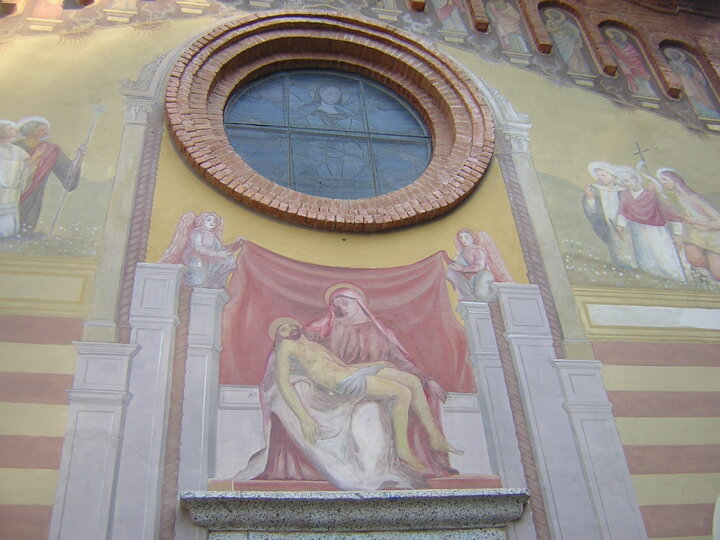
The gabled façade features a large terracotta rose window with the picture of Mary (visible inside) and a central granite portal with frescoed jambs between two decorated middle windows, under which the benefactors are mentioned. The portal is crowned by a fresco of the “Pietà”.
The lower part of the façade is decorated with wide bands according to the Tuscan Romanesque style; the upper part, corresponding to the pinnacle of the roof, is decorated in terracotta with large hanging arches, where there are frescoes of the apostles with Christ the Redeemer in the middle and the Blessed Virgin Mary on his right.
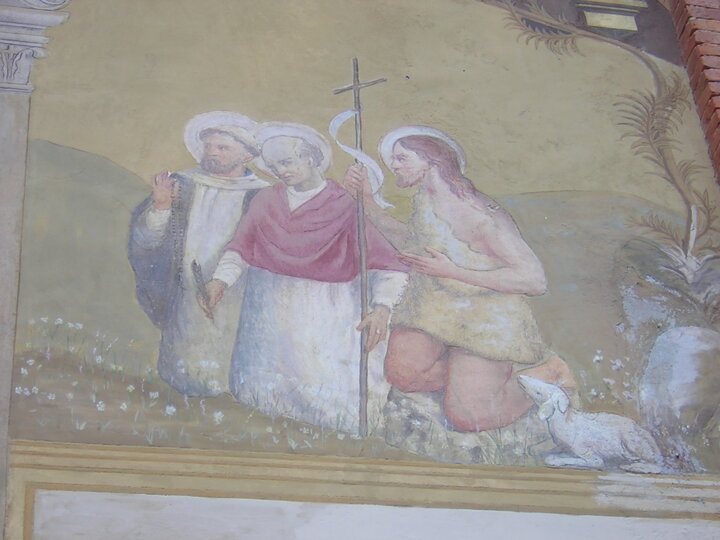
On both sides of the rose window, there are two groups of saints: on the left, Saint Roch, Saint Louis (?), and Saint Philip (?); on the right, Saint Dominic, Saint Pius X, and Saint John the Baptist.
On the façades of the two side aisles, there are small hanging arches with a group of female and male saints on the left and right respectively. At the bottom, there are two small doors that are rarely used, except for service purposes. On the right aisle, there is a plaque in memory of Don Gaudenzio Squaratti for the expansion of the shrine and his particular boost to Marian devotion.
On the right side of the shrine there is a driveway portico with a wooden roof, on whose left wall you can see the impressions of four windows.
On the left side of the church, there is a small walkway that allows you to walk around the building to reach the crypt. After descending a few steps, you reach the crypt, dated 1570, inside which there is an ancient inscription on a stone.
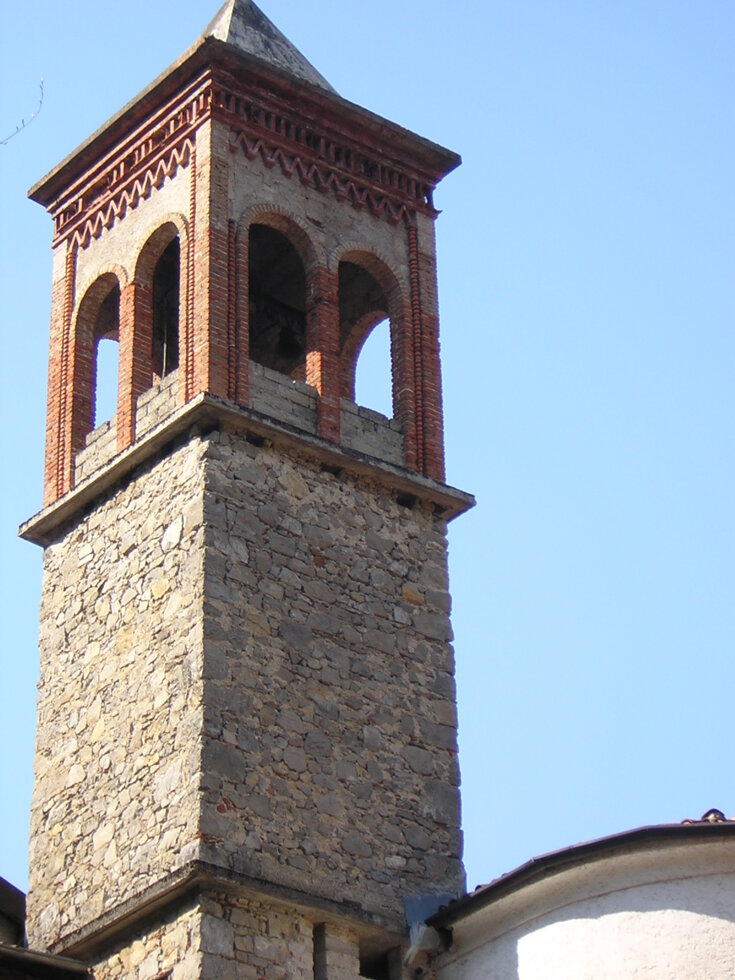
Further on, there is the bell tower and, crossing the portico, you return to the square in front of the main entrance.
The interior
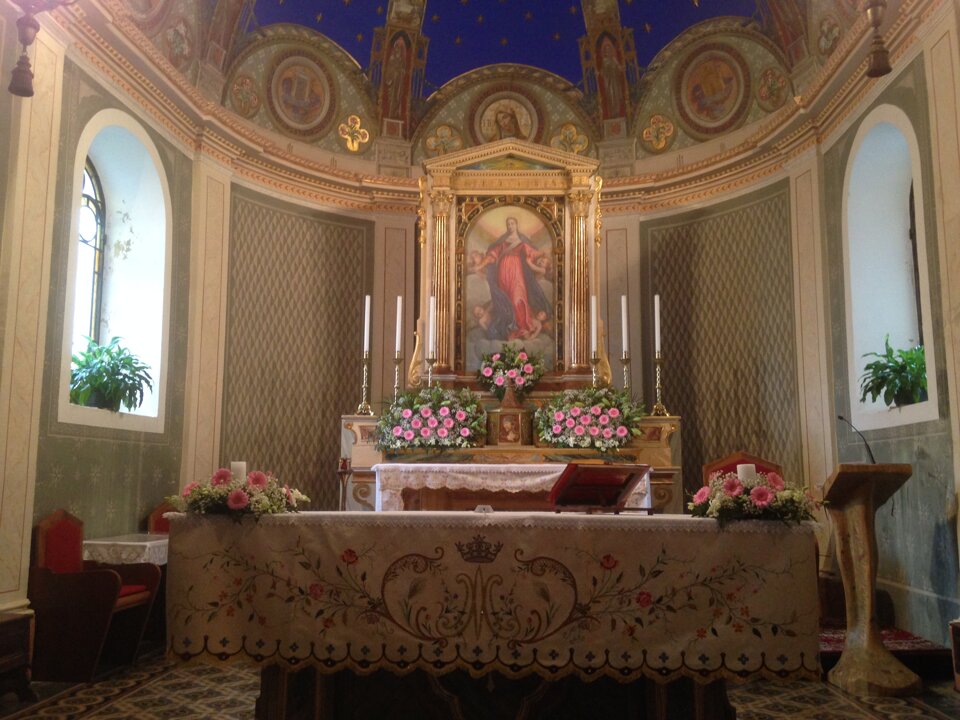
The interior of the shrine has a classical structure with pillars and arches. The ceiling is a wide coffered ceiling, the polylobate apse with a radiated apsidal basin is decorated with a starlit sky (243 stars). The individual polygonal sides of the apse are crowned with representations of St. Basil, St. Roch, St. Paul, St. Peter, St. John and St. Sebastian. The medallions feature Marian titles and the three theological virtues in the following order: Foederis arca, Spes, Ianua coeli, Fides, Domus aurea, Charitas, Ianua coeli. In the upper part of the nave, above the side arches preceding the triumphal arch, St. Lawrence, St. John the Baptist and St. Thomas are depicted on the left side, while St. Peter, St. Stephen and St. Paul are depicted on the right side. On the triumphal arch there are two angels on either side, one on the left carrying a thurible and one on the right carrying floral offerings. The altar is dossal-shaped within a golden wooden altarpiece in classical style with the famous painting of the Madonna of Rio Secco. The eye of God is represented in the small tympanum. The four evangelists are represented at the front and at the back of the aisles, respectively St. John and St. Mark on the left and St. Luke and St. Matthew on the right. In the right aisle, there is also an altar dedicated to St. Joseph.
Masses and celebrations - Year 2026
The Shrine will be open from the 1st of May until the first Sunday of October.
During this period, you can participate in religious services celebrated on both feast days and some weekdays. In addition, half an hour before each Holy Mass, we will recite the Rosary together.
We joyfully look forward to sharing moments of spirituality and prayer with you!
Please consult the timetables in the following tables or go to the news section of the website where the programmes for all other holidays or Marian celebrations will be published in due time.
Weekdays
May: Every Tuesday at 8.30 a.m.
June: Every Tuesday at 8.30 a.m.
July: Every Tuesday at 8.30 a.m.
August: Every Tuesday at 8.30 a.m.
September: Every Tuesday at 8.30 a.m.
Holidays
May: EVERY SUNDAY at 5 p.m.
June: EVERY SUNDAY at 5 p.m.
July: EVERY SUNDAY at 5 p.m.
August: EVERY SUNDAY at 5:00 p.m.
September: EVERY SUNDAY at 5:00 p.m
How to reach the Shrine
You can reach Rio Secco:
- From Brescia railway station, taking scheduled buses up to Capovalle.
- From A4 motorway, take Brescia EST exit, then SS 45 Bis and subsequently SS 237 towards Madonna di Campiglio. In Idro, turn onto SP58 towards Capovalle. Two kilometres before the town centre, you will find the turn-off for the Shrine.
ATTENTION: this last stretch is not accessible to large coaches.
- Coaches can park in the village of Capovalle.
- Small buses can be rented on site for the last stretch about 2 km long (from the crossroads on the SP58 to the shrine).
Image gallery
Il Campanile
Il Rosone e la "Pietà"
San Domenico, San Pio X e San Giovanni Battista
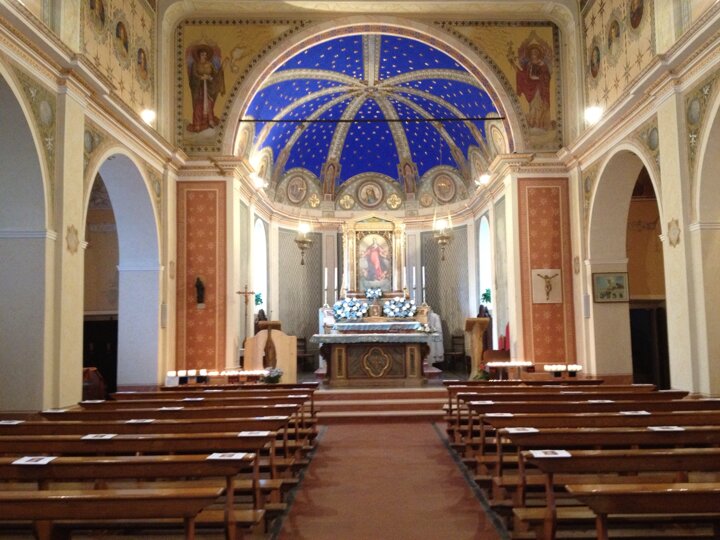
L'interno del Santuario
Santuario della B.V. di Rio Secco
25070 Capovalle (BS)
Loc. Rio Secco
Italia